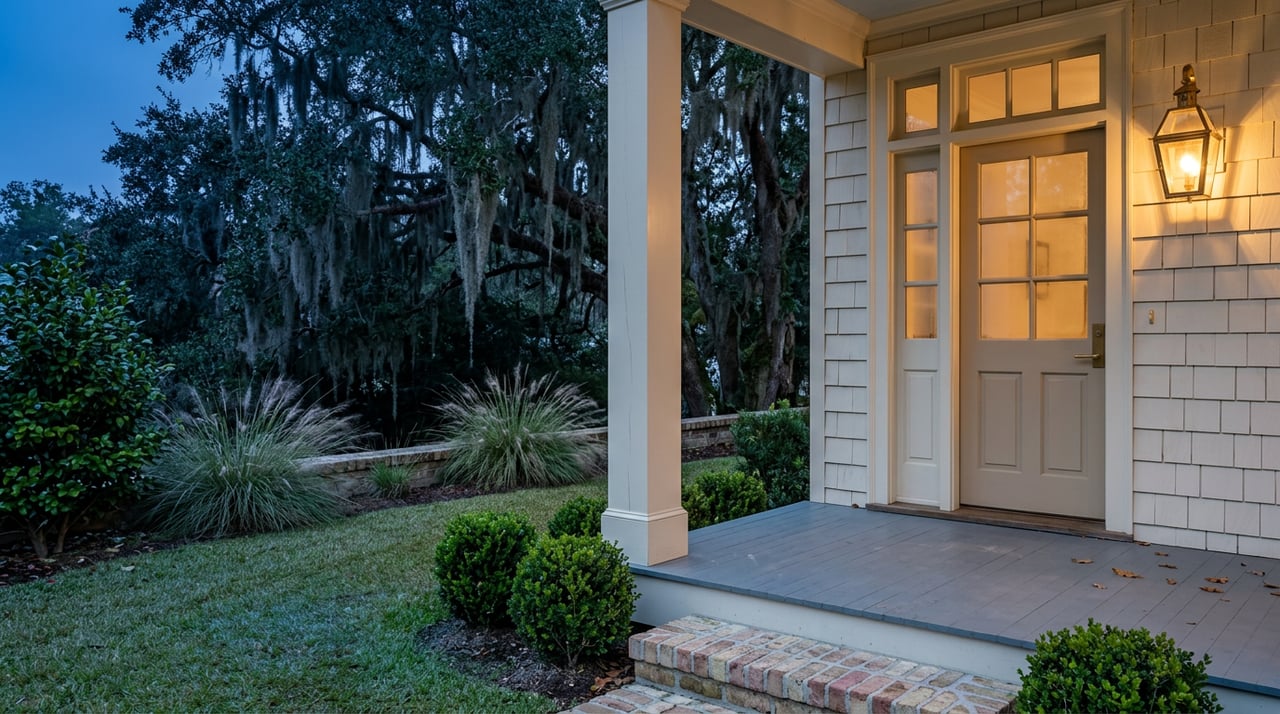
The east wind picks up after an afternoon storm. The bay goes glassy by ten. Somewhere down the bluff a porch light snaps on at two in the morning, then another, and if you have lived in Montrose long enough you know to reach for a headlamp and a five-gallon bucket before you are fully awake.
This is jubilee weather. And Montrose sits inside the narrowest, most reliable band of shoreline on Earth where it happens.
The stretch of shore that reads the bay first
Jubilees are most common on the upper eastern shore of the bay, from Point Clear to slightly north of Daphne, and Montrose sits squarely inside that corridor. A jubilee in Fairhope draws a crowd to the municipal pier. A jubilee at Mayday Park in Daphne makes the WKRG feed. What happens in between, along the residential bluff running through Montrose, tends to stay a neighbor-to-neighbor event because the shoreline itself is private.
That private character is not incidental. The Montrose Historic District comprises fifteen historically significant buildings, is almost entirely residential with the exception of the 1890 Montrose Post Office, and several homes in the district occupy bayfront lots. When the bay turns, the people who see it first are the ones sitting on their own porches. There is no boardwalk to line up along. The flounder come ashore in someone's yard.
That geography changes the etiquette of a jubilee in Montrose. It is why longtime residents keep a working phone tree, why the porch lights matter, and why the sound of a truck idling on Main Street at three in the morning is a signal rather than a nuisance.
Reading the signs
The mechanism is well documented. Jubilees are caused primarily by up-wellings of oxygen-poor bottom waters forcing bottom-type fish and crustaceans ashore. Bottom water low in oxygen results from several coincidental circumstances: pockets of salty water accumulate in the deep parts of the northern portion of Mobile Bay and stagnate during calm conditions. The stagnation is caused by salinity stratification, with the heavier salty Gulf water overlain by lighter, fresher river water. Stratification prevents movement of oxygen from the air into the bottom saline water.
That is the physics. The observational shorthand that gets passed down on the bluff is simpler. Researcher Hugh Loesch's five recurring signals, cataloged over decades of witness accounts, still hold up:
- Jubilees occur only in the summer.
- They usually occur in early morning hours, before sunrise.
- The wind on the day previous and during the jubilee is from some easterly direction.
- If wind direction changes, the jubilee will cease.
- There is a rising tide during a jubilee; a change to falling will stop the jubilee.
August is the month to watch most closely. Environmental conditions must be just right for a jubilee, with August usually being the best month, although they can also occur in September. Old-timers add one more tell: jubilees most often follow an afternoon rain shower and an easterly or northeasterly wind.
The scale can be misleading. Sometimes a 15-mile stretch of coast representing most of the eastern shore can be affected, and at other times the extent can be limited to as little as 500 feet of coastline. Smaller jubilees occur more frequently than larger ones, but can be difficult to find. A quiet summer is not the same as a jubilee-less summer. It probably means the small ones happened three blocks down while you were asleep.
What the law says you can take
The romance of the event has not kept pace with regulation. A generation ago you could fill a truck bed. Today the harvest rules are specific, and they apply the same during a jubilee as any other night on the bay. Worth knowing before you wade in:
| Species | Limit | Notes |
|---|---|---|
| Flounder | 5 per person | Minimum length 14 inches |
| Shrimp (heads on) | 1 five-gallon bucket per day | Recreational cast net limit |
| Blue crab | 1 five-gallon bucket per day | 5-inch minimum carapace, point to point |
The Alabama Marine Resources Division instituted the bag and size limits about a decade ago, after the flounder population in state waters had declined significantly. Flounder have responded and appear to be rebounding. That rebound is the reason a Montrose porch in August can, once every few years, still watch a proper flounder jubilee unfold at the waterline.
The paperwork side is easy to miss at two in the morning. All jubilee participants ages 16 to 64 who harvest shrimp by cast net or harvest any finfish like flounder, speckled trout and redfish are required to have an Alabama saltwater fishing license, and those 16 and older are required to have a saltwater angler registry. The registry is free. The citation for not having it is not.
The house that is testing the district this year
Summer on the bluff is not only about the water. It is also about the buildings that watch the water, and this year one of them is at the center of a preservation question that matters to anyone who owns inside the district.
In January 2026, the Fairhope Times reported that a potential new owner of the property at 23561 Main Street in the county's Montrose Historic District may decide to demolish it and build something new there if no suitable alternative plan is developed. It was the home of well-known Montrose resident Virginia Taylor and her husband William for many years before she passed away; relatives in New Orleans have the property up for sale. Built in 1855 by William Brainard, the 170-year-old Creole Cottage style home is also sometimes referred to as the Brainard-Breckenridge house in historic documents. It is locally known as Seven Gables.
The county's response is instructive for anyone considering a renovation, an addition, or a teardown inside the district. The Baldwin County Historical Districts Architectural Review Board recently declined to authorize demolition in favor of a six-month period to study alternatives like restoration or relocation. That six-month clock is the district functioning as designed. Baldwin County's Architectural Preservation Review Board oversees four historic districts including Montrose, its authority extends to the exterior of any structure being erected, renovated, or demolished, and it meets on the second Tuesday of each month. If you own a Creole cottage on Main Street, that meeting schedule is worth knowing in advance rather than in the middle of a project.
The Seven Gables review will resolve one way or another this year. Whichever way it lands, it will shape what the next buyer of an 1850s cottage in Montrose can and cannot do with the roof, the porch, and the setback. Watching it play out is not a spectator sport for district owners. It is a preview.
After the bay quiets down
The tide goes back out. The porch lights go off. Summer eases into fall, and the shoreline social calendar shifts a few miles north.
The 2026 Jubilee Festival of Arts has permanently moved to Lott Park in Olde Towne Daphne, and the Eastern Shore Chamber of Commerce hosts the festival each year to support tourism and the arts and spotlight the beauty and fun of Olde Towne Daphne. The new location matters. Lott Park is a shorter drive from most of Montrose than the old footprint, and parking sits at Daphne Elementary on the north end and Daphne City Hall on the south end.
Dates for this year: 10 a.m. to 5 p.m. on October 17 and 10 a.m. to 4 p.m. on October 18, 2026. The festival features more than 140 local and regional artists, plus a food-makers market. It is the closest thing the eastern shore has to a bookend on the summer, and if a jubilee has already come and gone by then, half the porches you pass on the way there will still smell faintly of flounder.
A note on where this leaves owners
Living on the Montrose bluff in July and August is a specific kind of attention. You are watching the wind. You are watching the historic review calendar. You are keeping a bucket by the back door because a phenomenon that only regularly occurs in two places on Earth might, once again this summer, happen inside your property line.
If you are thinking about buying into that stretch of shoreline, or about selling a home whose porch has watched forty jubilees, the details in this post are the ones that shape value in ways the portal listings do not show. Reach out to Bo Nichols to talk about what a Montrose bayfront or historic-district home actually means to own, and what it takes to move one well.